
Music Therapy for Children in Special Education: Communication, Connection, and Classroom Engagement
Article Overview
This pilot study explored whether a classroom-based music therapy program could help improve communication for children with developmental disabilities, including autism, in special education settings. Researchers examined the Voices Together model, a structured intervention that uses interactive songs, vocal prompting, and group participation to encourage verbal responses and social engagement during music therapy sessions.
Children took part in weekly 45-minute sessions led by a trained music therapist, with one group receiving the program for 15 weeks and another for 7 weeks. The study found that children in the longer-term group showed stronger gains in verbal responsiveness during the sessions, while the shorter-term group showed improvement that was not statistically significant. Although teacher rating scales did not show broad changes across classroom behavior, direct observations suggested that classroom music therapy may support communication development over time.
Why This Matters
Children in special education settings often need support with communication, social interaction, and classroom participation. Music therapy can offer a structured and engaging way to practice these skills, especially for children who may respond well to rhythm, repetition, and musical interaction. This makes classroom-based music therapy especially relevant for schools looking for supportive, relationship-based interventions.
This study also matters because it looks at music therapy in a real educational setting, not just in a clinic or one-to-one session. For educators, therapists, and families, that helps show how music therapy can fit into everyday school life and support children where they already learn and interact. Even though the findings are preliminary, the study adds to the growing evidence that music therapy can play a meaningful role in special education.
Mendelson, J., White, Y., Hans, L., Adebari, R., Schmid, L., Riggsbee, J., Goldsmith, A., Ozler, B., Buehne, K., Jones, S., Shapleton, J., & Dawson, G. (2016). A preliminary investigation of a specialized music therapy model for children with disabilities delivered in a classroom setting. Autism Research and Treatment, 2016, Article 1284790. https://doi.org/10.1155/2016/1284790
Read The Full Article
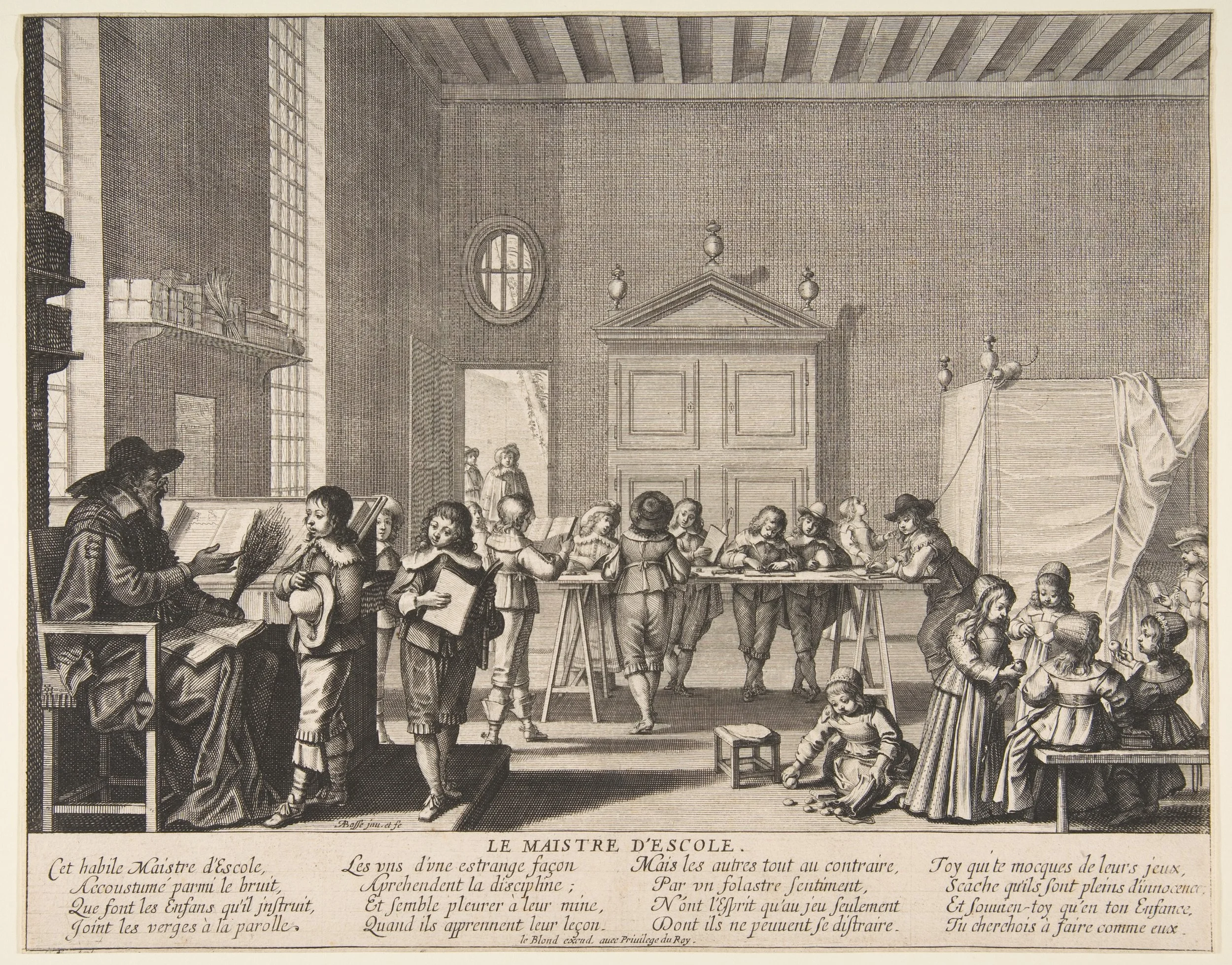
The School Master, Abraham Bosse, ca. 1635–1638.