
Music Therapy Resources
Explore free and open-access music therapy research, article summaries, and educational resources curated by Revival Jam. Search the library below for topics spanning autism, depression, anxiety, quality of life, dementia, and more.
Music Therapy for Children with Autism: Social Skills, Language, and Development
This 2025 randomized controlled trial explored whether music therapy could support social skills in children with autism spectrum disorder. Across 12 weeks, the findings suggest benefits in social communication, language-related scores, sociability, and child development outcomes.
Article Overview
Music therapy is increasingly being explored as a supportive intervention for children with autism spectrum disorder, especially in areas related to social communication and language. In this 2025 randomized controlled trial, researchers examined whether adding music therapy to standard care could improve social skills in children with ASD. The study included 29 children, with 15 in the music therapy group and 14 in the control group.
The music therapy program was delivered in small groups of 3–5 children, for 30 minutes, three times a week, over 12 weeks. According to the abstract, children in the music therapy group showed significantly better outcomes in social communication, speech/language/communication, sociability, and the social domain of developmental assessment compared with the control group. The authors conclude that music therapy may be an effective complement to regular social skills training, while the small sample size means the findings should still be interpreted with appropriate caution.
Why This Matters
This article matters because social communication, language, and relationship-building are central concerns for many children with autism and their families. The study suggests that music therapy may support these areas in a structured, child-centered format that combines musical activities with social skills work. That gives your library a research article that is both highly relevant to families and strong for search terms related to autism, social skills, language development, and music therapy.
It is also useful to frame the study transparently. This was a randomized controlled trial, which is a stronger design than many descriptive or conceptual papers, but it was still a small study with only 29 participants. In addition, the intervention was described as being led by an occupational therapist and combining social skills training with musical activities, so it is best presented as a promising structured intervention rather than definitive proof about all music therapy approaches for autism.
Zhou, Z., Zhao, X., Yang, Q., Zhou, T., Feng, Y., Chen, Y., Chen, Z., & Deng, C. (2025). A randomized controlled trial of the efficacy of music therapy on the social skills of children with autism spectrum disorder. Research in Developmental Disabilities, 158, 104942. https://doi.org/10.1016/j.ridd.2025.104942
Read The Full Article
Studies of Two Men and a Woman Teaching a Child to Walk, Nicolaes Maes, Circle of Rembrandt (Rembrandt van Rijn), 1645–50
Music Therapy for Autistic Children: Attunement, Social Motivation, and Emotional Connection
A 2025 mixed-methods study found that improvisational music therapy may support social motivation, emotional connection, and developmental growth in young autistic children. The study highlights the role of therapist-child attunement in building engagement, communication, and parent-reported quality of life.
Article Overview
This 2025 embedded mixed-methods study explores how improvisational music therapy may support non-speaking and minimally speaking young autistic children through attunement, affect sharing, and relationship-based music making. Fifteen children participated in a year-long program, with researchers examining changes in social affect, developmental levels, parent quality of life, and the therapeutic processes described by parents and therapists.
The study found significant improvements in children’s social-affect scores and developmental levels, along with improved parent quality of life after the year-long improvisational music therapy program. A central finding was the importance of “musical-emotional attunement,” with higher attunement linked to stronger therapeutic relationships, greater social motivation, and better outcomes across child and parent measures.
Why This Matters
This article is especially valuable because it helps explain not only whether improvisational music therapy may be helpful for autistic children, but also how it may work. The authors describe attunement, interaffectivity, and therapist-child responsiveness as central to building trust, engagement, and social motivation in young autistic children.
For a public-facing music therapy library, this study is a strong fit because it highlights a child-led, relationship-based approach that many families and professionals want to understand more deeply. It also supports a strengths-based view of autism while showing how music therapy may contribute to social-emotional development, communication, and family well-being.
Kim, J., & Lee, J. (2025). Tuning in and sharing affects: Fostering social motivation in young autistic children in improvisational music therapy – an embedded mixed-methods study. The Arts in Psychotherapy, 95, 102334. https://doi.org/10.1016/j.aip.2025.102334
Read The Full Article
Head of a Child, Jacques Louis David
Music Therapy for Children in Special Education: Communication, Connection, and Classroom Engagement
A pilot study examining classroom music therapy found that structured music sessions can support communication development for children with autism and other developmental disabilities. Students who participated in longer-term music therapy showed increased verbal responsiveness and engagement during classroom activities.
Article Overview
This pilot study explored whether a classroom-based music therapy program could help improve communication for children with developmental disabilities, including autism, in special education settings. Researchers examined the Voices Together model, a structured intervention that uses interactive songs, vocal prompting, and group participation to encourage verbal responses and social engagement during music therapy sessions.
Children took part in weekly 45-minute sessions led by a trained music therapist, with one group receiving the program for 15 weeks and another for 7 weeks. The study found that children in the longer-term group showed stronger gains in verbal responsiveness during the sessions, while the shorter-term group showed improvement that was not statistically significant. Although teacher rating scales did not show broad changes across classroom behavior, direct observations suggested that classroom music therapy may support communication development over time.
Why This Matters
Children in special education settings often need support with communication, social interaction, and classroom participation. Music therapy can offer a structured and engaging way to practice these skills, especially for children who may respond well to rhythm, repetition, and musical interaction. This makes classroom-based music therapy especially relevant for schools looking for supportive, relationship-based interventions.
This study also matters because it looks at music therapy in a real educational setting, not just in a clinic or one-to-one session. For educators, therapists, and families, that helps show how music therapy can fit into everyday school life and support children where they already learn and interact. Even though the findings are preliminary, the study adds to the growing evidence that music therapy can play a meaningful role in special education.
Mendelson, J., White, Y., Hans, L., Adebari, R., Schmid, L., Riggsbee, J., Goldsmith, A., Ozler, B., Buehne, K., Jones, S., Shapleton, J., & Dawson, G. (2016). A preliminary investigation of a specialized music therapy model for children with disabilities delivered in a classroom setting. Autism Research and Treatment, 2016, Article 1284790. https://doi.org/10.1155/2016/1284790
Read The Full Article
The School Master, Abraham Bosse, ca. 1635–1638.
Music Therapy for Autism Spectrum Disorder: Social Interaction, Communication, and Connection
Music therapy for autism may support social interaction, verbal and nonverbal communication, initiating behavior, and social-emotional reciprocity in children with autism spectrum disorder. This research overview from Revival Jam highlights what a major Cochrane review found and why it matters for families, educators, and clinicians.
Article Overview
Music therapy uses musical experiences and the relationships that develop through them to support communication, expression, and connection. In this Cochrane systematic review, researchers examined the effects of music therapy for children with autism spectrum disorder, with a focus on social interaction, verbal and non-verbal communication, initiating behavior, and emotional reciprocity.
The review suggests that music therapy may help improve social interaction, verbal communication, initiating behavior, and social-emotional reciprocity. The authors also describe possible benefits in areas such as social adaptation, joy, and the quality of parent-child relationships, while noting that more research is still needed.
Why This Matters
Autism support often involves more than reducing challenges. It also includes creating opportunities for connection, expression, relationship-building, and meaningful engagement. This review is important because it highlights music therapy as a relational and interactive approach that may support communication and social development in ways that feel motivating and accessible.
For families, educators, and clinicians, this review offers a helpful overview of how music therapy may support children with autism in areas that matter deeply in daily life. It also reinforces the idea that music therapy is not simply passive listening, but a trained, relationship-based process that can support growth in communication and social connection.
Geretsegger, M., Elefant, C., Mössler, K. A., & Gold, C. (2014). Music therapy for people with autism spectrum disorder. Cochrane Database of Systematic Reviews, 2014(6), CD004381. https://doi.org/10.1002/14651858.CD004381.pub3
Read The Full Article
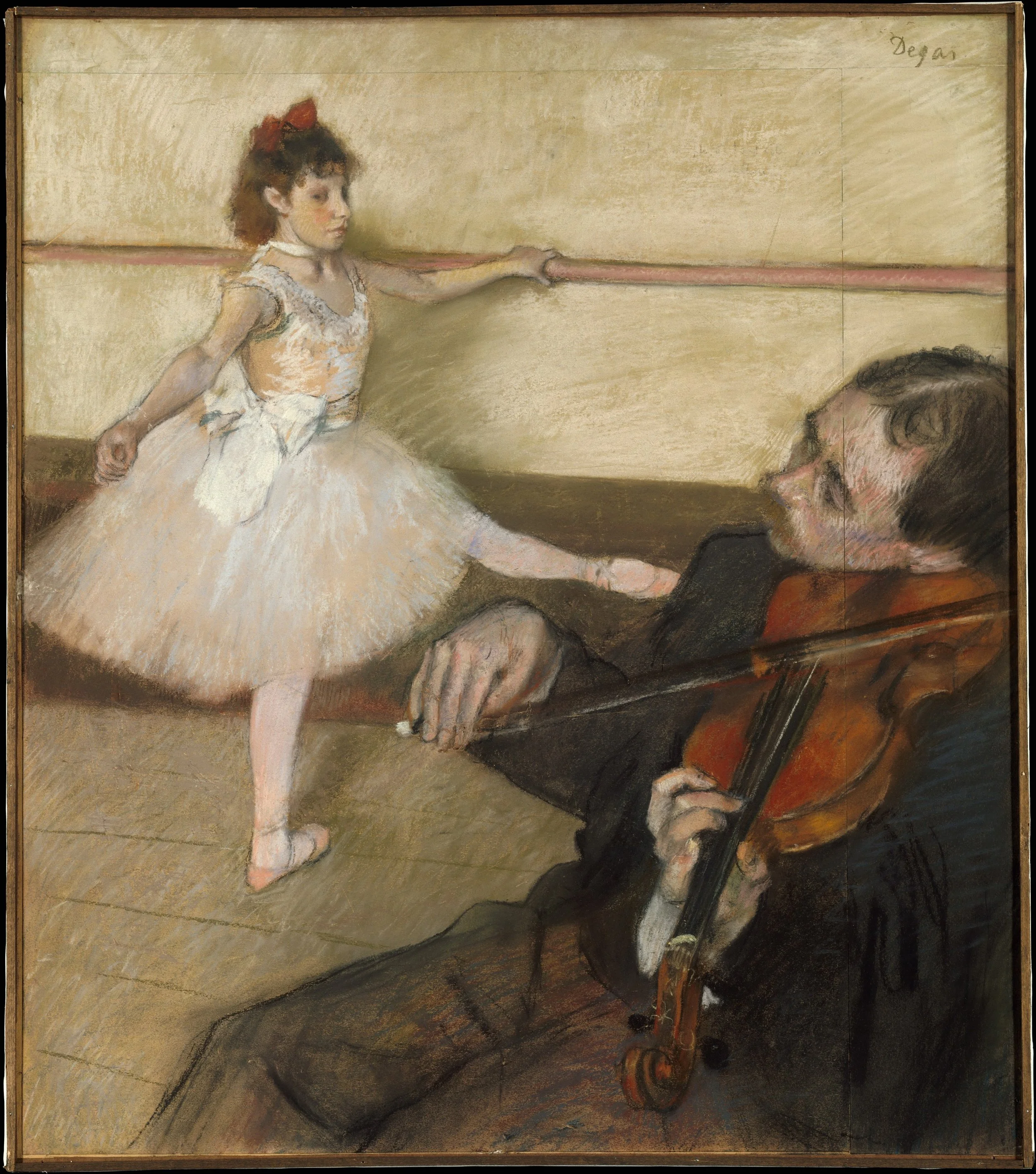
The Dance Lesson, Edgar Degas, ca. 1879.